

The facts, then. On May 1, 1903, a Black man named Will West arrived at the United States Penitentiary in Leavenworth, Kansas, to begin serving a sentence for a minor crime . He went through the standard admission procedure: mugshots, physical description, and eleven precise anthropometric measurements.
The identification clerk took Will West’s measurements, consulted his files, and returned with a card bearing a familiar name: William West . The measurements were almost identical. The photograph was a near-perfect match. The clerk assumed Will West was lying about his identity.
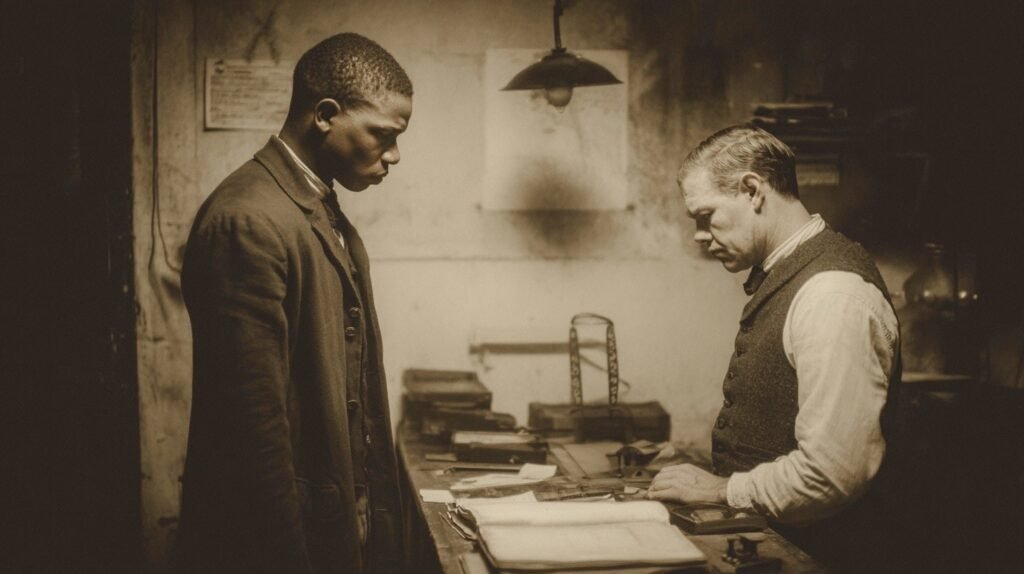
“There’s my picture,” West reportedly said, grinning in amazement, “but I don’t know where you got it, for I know I have never been here before”. The clerk turned the card over. It revealed that this “William West” was already an inmate at Leavenworth serving a life sentence for murder since September 9, 1901.
When officials went to find this other William West, they discovered him sleeping peacefully in his cell. The two men, brought face to face, could have been looking into mirrors. Even their names were nearly identical. Yet they were not brothers. Not cousins. Not related in any known way.

The System That Failed
At the time, American prisons relied on the Bertillon system, named after French anthropologist Alphonse Bertillon which combined photographs, body measurements, and anatomical descriptions with claims of mathematical precision. The chance of two people sharing identical measurements was estimated at around four million to one. Will and William West were that one.
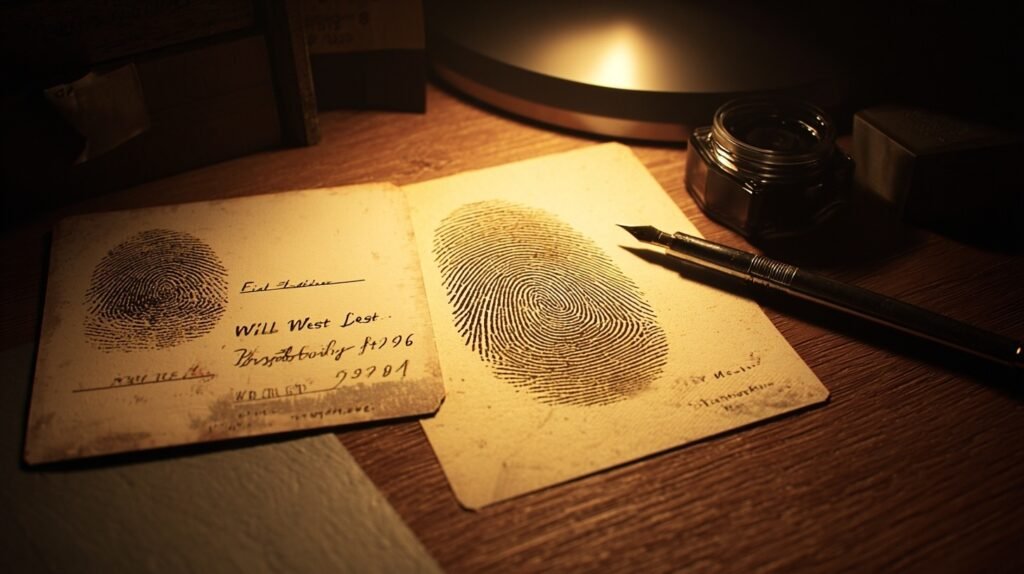
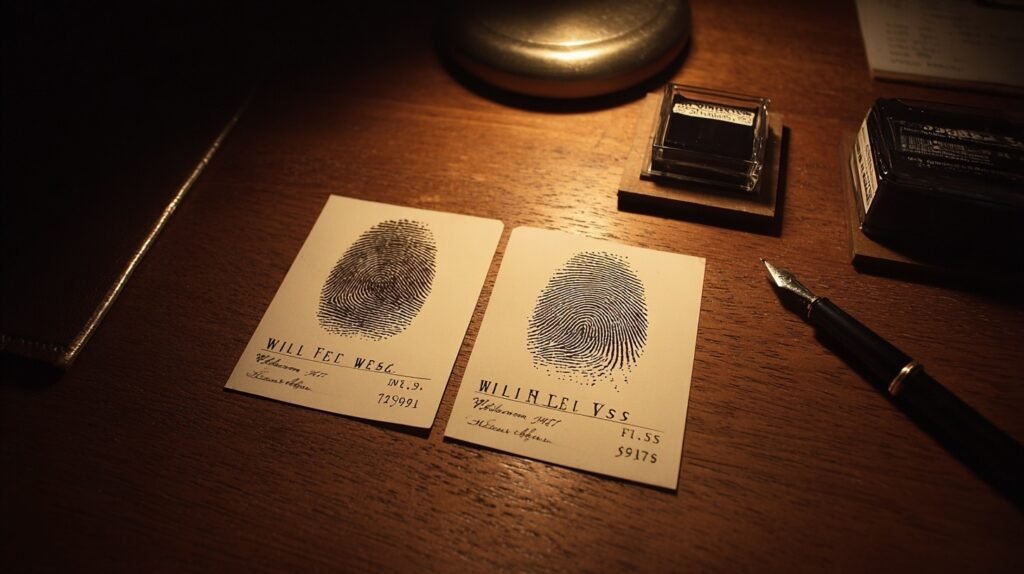
Only their fingerprints could tell them apart. Investigators compared the two men’s prints and found dramatically different patterns, one had loops, the other whorls. The difference, invisible to the human eye in photographs, was irrefutable to science.
The Aftermath: A Revolution in Forensics
The West case did not single-handedly end the Bertillon system. But it became the powerful, real-world example that fingerprint advocates needed. In 1904, at the St. Louis World’s Fair, prison official M.W. McClaughry, son of Leavenworth’s warden met Sergeant John K. Ferrier, a fingerprint expert from Scotland Yard. Ferrier already used fingerprints successfully in the United Kingdom.
McClaughry invited him to implement the system at Leavenworth. In November 1904, the penitentiary became the first federal prison in the United States to adopt a fingerprint filing system . Every inmate was registered. Will West became file number 927. William West became file number 9372 . St. Louis police officers, impressed by the World’s Fair display and the Leavenworth case, became the first police department in the United States to keep a fingerprint database in October 1904.
The Fate of the Two Wests
Will West served a relatively short sentence for manslaughter and then disappeared from historical records. Some speculate he changed his name to escape the stigma of his look-alike’s murder conviction. William West remained in prison. In 1916, he attempted to escape by hiding in a delivery truck but was quickly recaptured, identified by his fingerprints and photographs. The same system that had prevented him from being confused with Will West also ensured he could never hide.
How Much of This Story Is True?
Some historians, including Simon Cole in his authoritative study Suspect Identities, argue the West story has been embellished. The Bertillon measurements for the two men were not perfectly identical, their foot lengths differed by seven millimetres, a significant deviation under the rigorous Bertillon protocol. Pro-fingerprinting activists may have exaggerated the case to promote their preferred technology.
Nevertheless, the core facts are undisputed: two unrelated Black men with nearly identical names and appearances were incarcerated at Leavenworth simultaneously. Their Bertillon measurements were alarmingly similar. Their fingerprints were distinct. This incident, whether perfectly documented or not, accelerated a global shift toward fingerprint identification.
Why This Story Matters
The case of Will and William West endures because it captures a moment when science took a decisive step forward, not through smooth progress, but through a spectacular failure that demanded a better solution. Today, fingerprints remain a cornerstone of forensic science. But the story of the two Wests reminds us that behind every technological breakthrough lies a human story: confusion, coincidence, and the stubborn refusal to accept “good enough” when lives and justice hang in the balance.
Sources
- National Law Enforcement Officers Memorial Fund (2010) – “West Brothers” Photograph, 1903
- ProtoThema English (2024) – “The Will and William West case: The identical inmates that showed the need for fingerprinting, 1903”
- KCUR (2015) – “How Look-Alike Leavenworth Prisoners Led To The Forensic Use Of Fingerprinting”
- ABC10 (2019) – “From a fair to fingerprinting: Here’s the history behind how we identify suspects”
- Infobae (2025) – “El caso West: dos hombres idénticos confundieron a una prisión en 1903 y cambiaron la historia forense”
- Mamamia (2017) – “The startling coincidence that led to the invention of fingerprinting”
- Dickinson College (n.d.) – “Fingerprints: the Convoluted Patterns of Racism”
- Salt Lake Telegram (1937) – “WEST MEETS WEST” (Newspaper Archive via University of Utah)
ALL IMAGES GENERATED WITH AI