
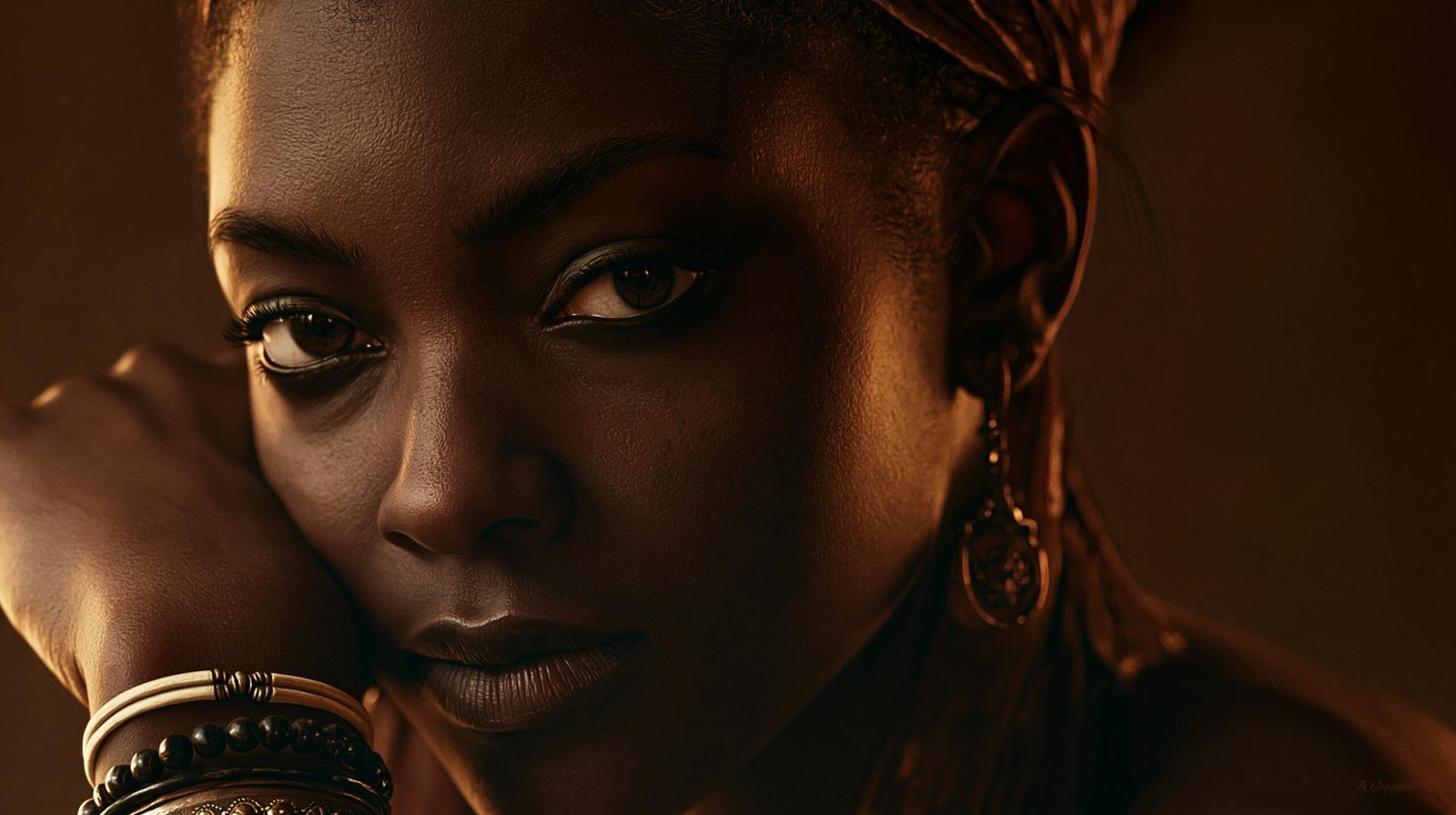

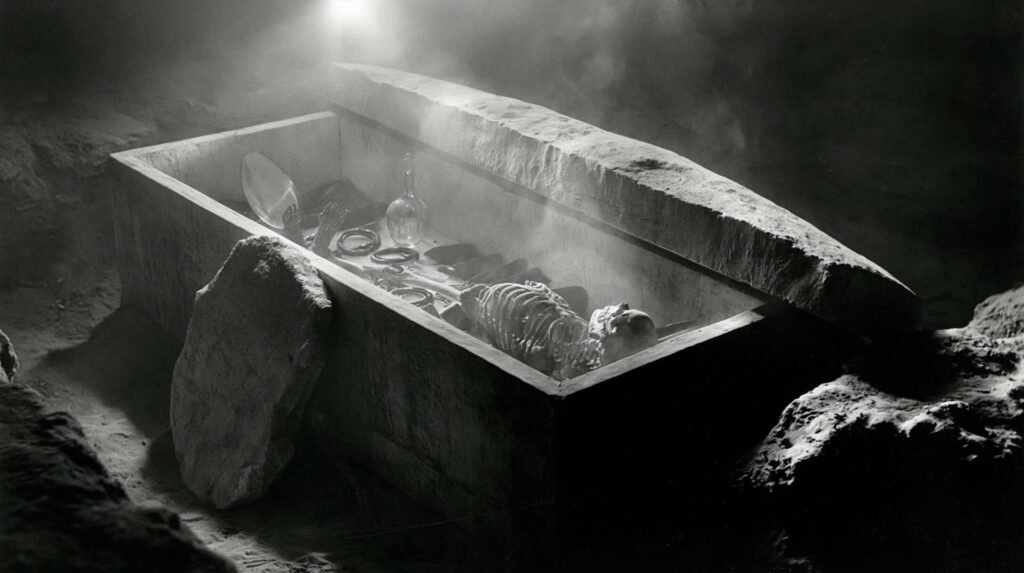
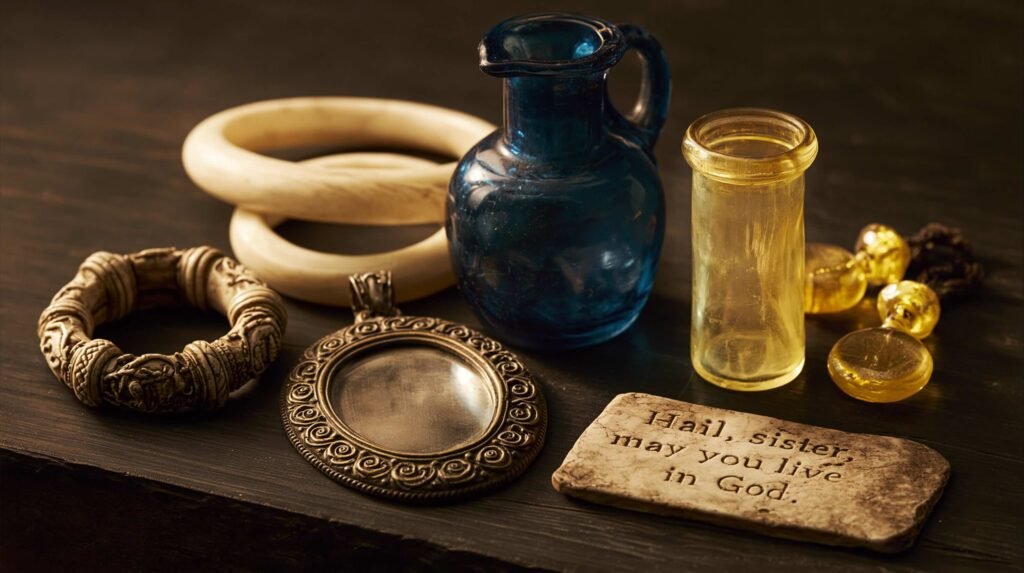
The facts, then. In 1901, workmen digging in Sycamore Terrace, York, discovered a stone sarcophagus. Inside was the skeleton of a young woman. She had been buried with extraordinary wealth: ivory and jet bracelets, earrings, pendants, a small mirror, and a blue glass flagon.
On a piece of bone, mounted perhaps on a wooden box, was an inscription carved in Latin: SOROR AVE VIVAS IN DEO. “Hail, sister, may you live in God.”
For decades, the woman remained unnamed—known only by the ivory bangles on her arm. In 2010, scientists at the University of Reading re-examined her skeleton. They studied the shape of her skull. They analyzed the chemical signatures preserved in her teeth. The results changed what we thought we knew.
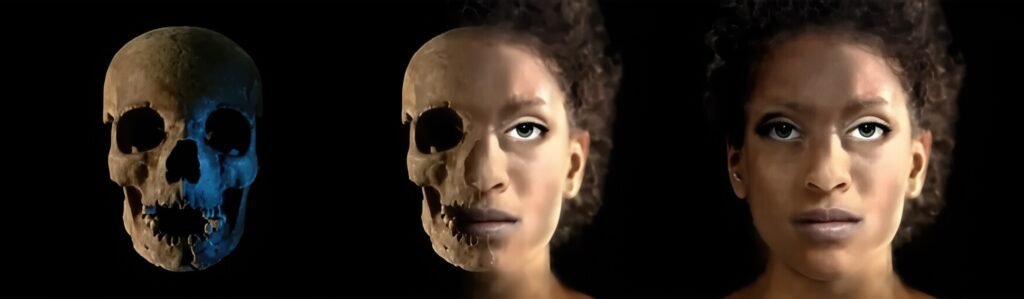
She was young, between 18 and 23 years old when she died. She was healthy, with no obvious cause of death. The stone sarcophagus and the wealth of her grave goods marked her as a woman of high status—a member of the uppermost strata of Roman York society.

Her skull showed a mix of “black” and “white” ancestral traits. The scientists concluded she had North African ancestry. She may have been a descendant of North African migrants, or she may have migrated herself.
The isotopes in her teeth told another part of the story. The ratios of oxygen and strontium in her enamel showed where she spent her childhood. She did not grow up in York. She grew up in a warmer climate, perhaps in the south of Britain, the Mediterranean, or a coastal region of Western Europe. She came to York from somewhere else. She was a migrant.
The Ivory Bangle Lady challenges the assumption that African individuals in Roman Britain were all low-status male slaves. She was a woman. She was wealthy. She was buried with honor. Roman York was a diverse city, connected to an empire that stretched across Europe, North Africa, and the Middle East. The Ivory Bangle Lady was part of that world.
York, known as Eboracum, was a legionary fortress and civilian settlement. It was visited by two Roman emperors, including Septimius Severus, who was born in North Africa. These connections created conditions for migration. The Ivory Bangle Lady and others like her walked the streets of Roman York.
The Ivory Bangle Lady is now a symbol of the fact that black presence in Britain is not a recent phenomenon. She was part of the island’s history from the very beginning of its place in the Roman world. In 2012, she was featured in the BBC series Black and British: A Forgotten History, presented by David Olusoga.
Sources:
- Wikipedia – Ivory Bangle Lady (https://en.wikipedia.org/wiki/Ivory_Bangle_Lady)
- BBC News – Roman remains are ‘elite’ African (2010) (https://www.bbc.com/news/uk-england-north-yorkshire-8538888)
- The Guardian – African origin of Roman York’s rich lady with the ivory bangle (2010) (https://www.theguardian.com/science/2010/feb/26/roman-york-skeleton)
- Sky HISTORY – The Ivory Bangle Lady and the multi-culturalism of Roman Britain
- The Independent – Evidence of ‘upper class’ Africans living in Roman York (2010) (https://www.independent.co.uk/life-style/history/evidence-of-upper-class-africans-living-in-roman-york-1914553.html)
- Our Migration Story – Roman Britain: the Ivory Bangle Lady (https://www.ourmigrationstory.org.uk/oms/roman-britain-the-ivory-bangle-lady)
- Yorkshire Post – Ebony and ivory: Roman York a model of diversity (2010) (https://www.yorkshirepost.co.uk/news/ebony-and-ivory-roman-york-a-model-of-diversity-1985321)
• • BBC Black and British – Ivory Bangle Lady (https://www.bbc.co.uk/programmes/articles/41Z57bgYcy2KZG3WmzzkXp8/black-history-month)