



The facts, then. In March 2026, UK Music released the first report of its kind in Europe. It proved what many inside the industry already knew. Black music is not a niche corner of the British market. It is the market. Over 30 years, from 1994 to 2023, Black music generated £24.5 billion out of a total £30 billion in UK recorded music revenue. That is 80 percent of the entire market.
Here is what those numbers actually look like on the ground.
The report breaks Black music into three tiers. Tier one includes Black British genres like grime, dubstep, and lovers rock. These 29 genres brought in £1.24 billion on their own.
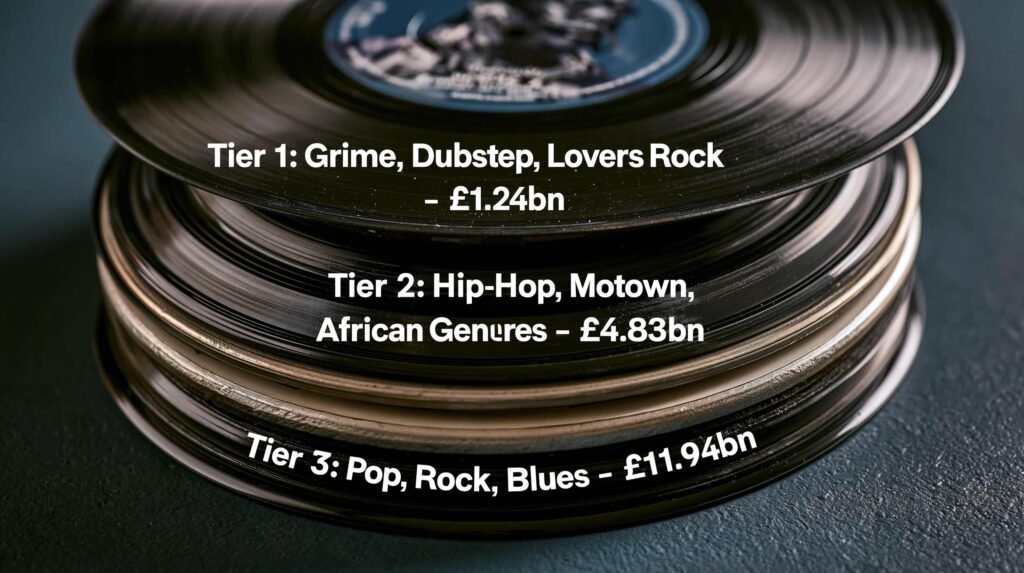
Tier two covers core Black music genres such as hip-hop, rap, Motown, and African genres. British artists working in these styles accounted for £4.83 billion in sales.

Tier three is the largest category. It includes genres that originated from Black music but are now produced by British artists across all backgrounds. This category covers blues, pop, and rock. It contributed £11.94 billion, which is 40 percent of the entire recorded music market.
You can see this in the artists named in the report. Stormzy, Little Simz, Central Cee, Dave, RAYE, Sault, Ezra Collective, Michael Kiwanuka, Soul II Soul, and Sade are all cited as examples of the global success Black British music has achieved.The report also provides an official definition of Black music for the first time. It says Black music is music rooted in the culture, beliefs, traditions, and history of Black people and the African diaspora. This applies regardless of the ethnicity of the musicians performing it.

Behind these numbers is a persistent problem. At senior industry levels, only 22 percent of the workforce identify as Black, Asian, or minority ethnic. Compare that to 46 percent of London’s population. Black artists and professionals also face a documented 20 percent pay gap, according to a 2021 Black Lives in Music report. Interviews with around 80 Black creators and executives confirmed patterns of inequity and barriers to progression.
The report ends with eight recommendations. One calls for recognising Black music genres within the school curriculum. Another asks the government to direct part of its £30 million Music Growth Package toward Black-led organisations and enterprises. A third recommends treating Black music performance spaces and studios as cultural landmarks requiring institutional funding.
MOBO founder Kanya King called the report important and fundamental. She said, “We all know the importance of Black Music and culture in this room, but now we can tell everybody else”.

UK Music chief executive Tom Kiehl put it plainly. Black music is integral to “powering music in the UK”.
The report was launched in Parliament on March 18, 2026, with speeches from MPs, peers, and industry leaders . It draws on research from Professor Mykaell Riley of the University of Westminster, whose Beyond the Bassline project first mapped 29 Black British genres and more than 130 genres rooted in Black musical traditions.
The 80 percent figure is not a projection. It is a calculation based on 30 years of actual sales data, streaming numbers, and market analysis. Black music did not just influence British music. It built it.

Sources:
- UK Music – Black Music Means Business report launch (2026)
- UK Music – Black Music Means Business full report (2026)
- Rolling Stone UK – New report reveals Black music’s staggering worth to UK economy (2026)
- The Irish News – Black music makes up 80% of UK recorded music revenue (2026)
- Yorkshire Evening Post – Black Music generates £24.5bn for economy (2026)
- University of Westminster – Westminster contributes to Black Music Means Business Report (2026)
- The Musicians’ Union – UK Music Report Reveals Economic Power of Black Music (2026)